Hello, I'm Jeremy Dinh
Quantitative by default | Construction cost estimation, CPM schedule engineering, and AI-orchestrated multidisciplinary analysis | Calgary, Alberta
The whole practice, one map
Loading the 3D world...
Construction AI: one system, every discipline
One deterministic front door, one integrated toolkit. Every query traverses the identical gauntlet: evidence stratification before inference, discipline specialists executed in parallel, contractual instruments locked before pricing, and multi-gate audit verification before release. The production stack:
Intake classification accuracy: 85.7% cost class · 81.3% schedule type, adjudicated behind a 0.90 confidence gate. Sub-gate classifications devolve to a deterministic router, with the divergence flagged, never suppressed. The layer is fail-open: model unavailability degrades the pipeline to its deterministic baseline, unchanged.
The swarm at work: a real case
Case study: the Calgary Cancer Centre (Arthur J.E. Child Comprehensive Cancer Centre): 127,000 m², 13 floors, 160 beds, 12 radiation vaults, on the Foothills campus. A public project (built by PCL, opened 2024), re-executed through the pipeline on public facts only: the coordination demonstrated, not asserted.
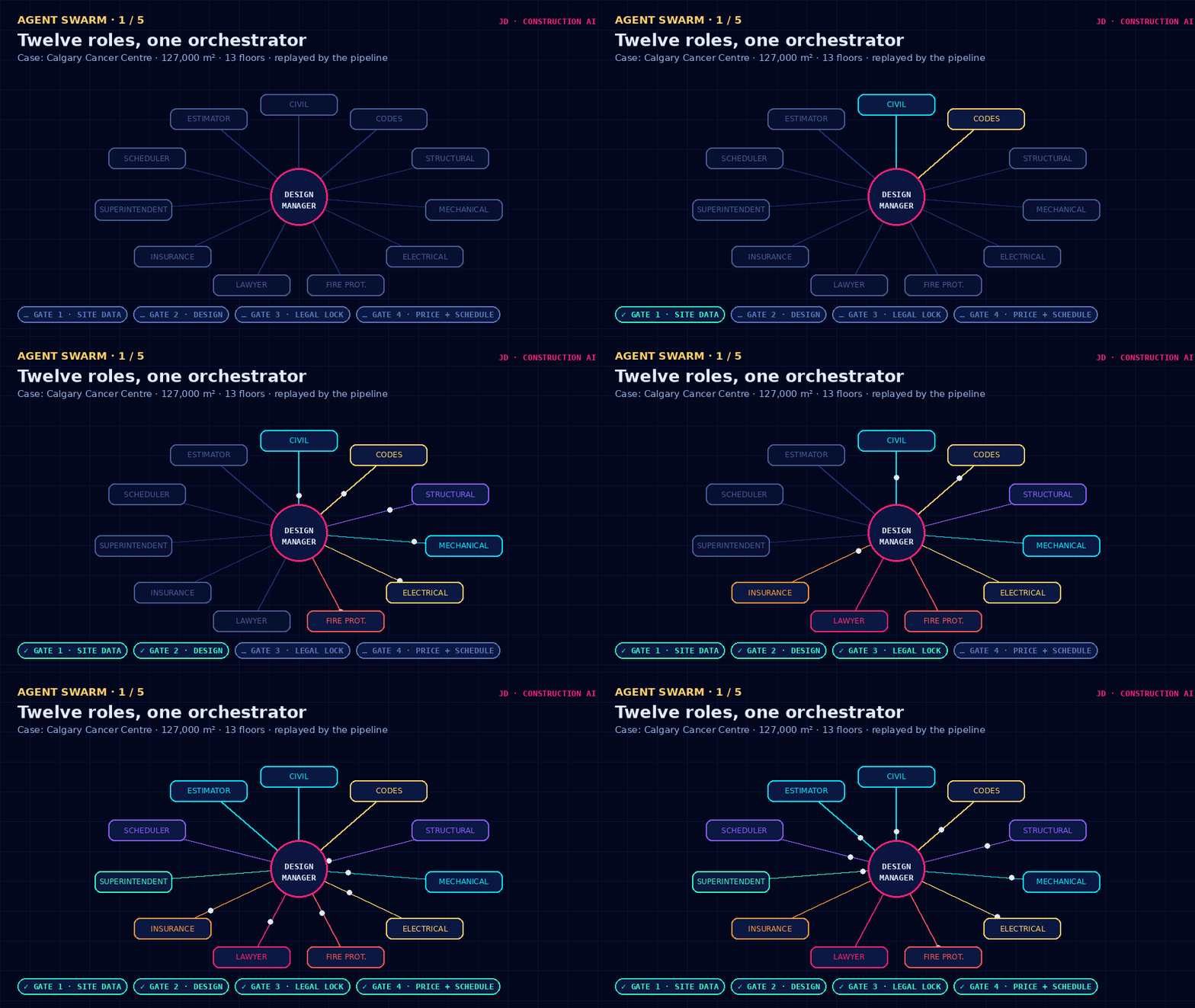
1 · The swarm assembles
The Design Manager dispatches 11 discipline agents in phase-gated waves: site intelligence, design development, contractual lock, then pricing and schedule synthesis.
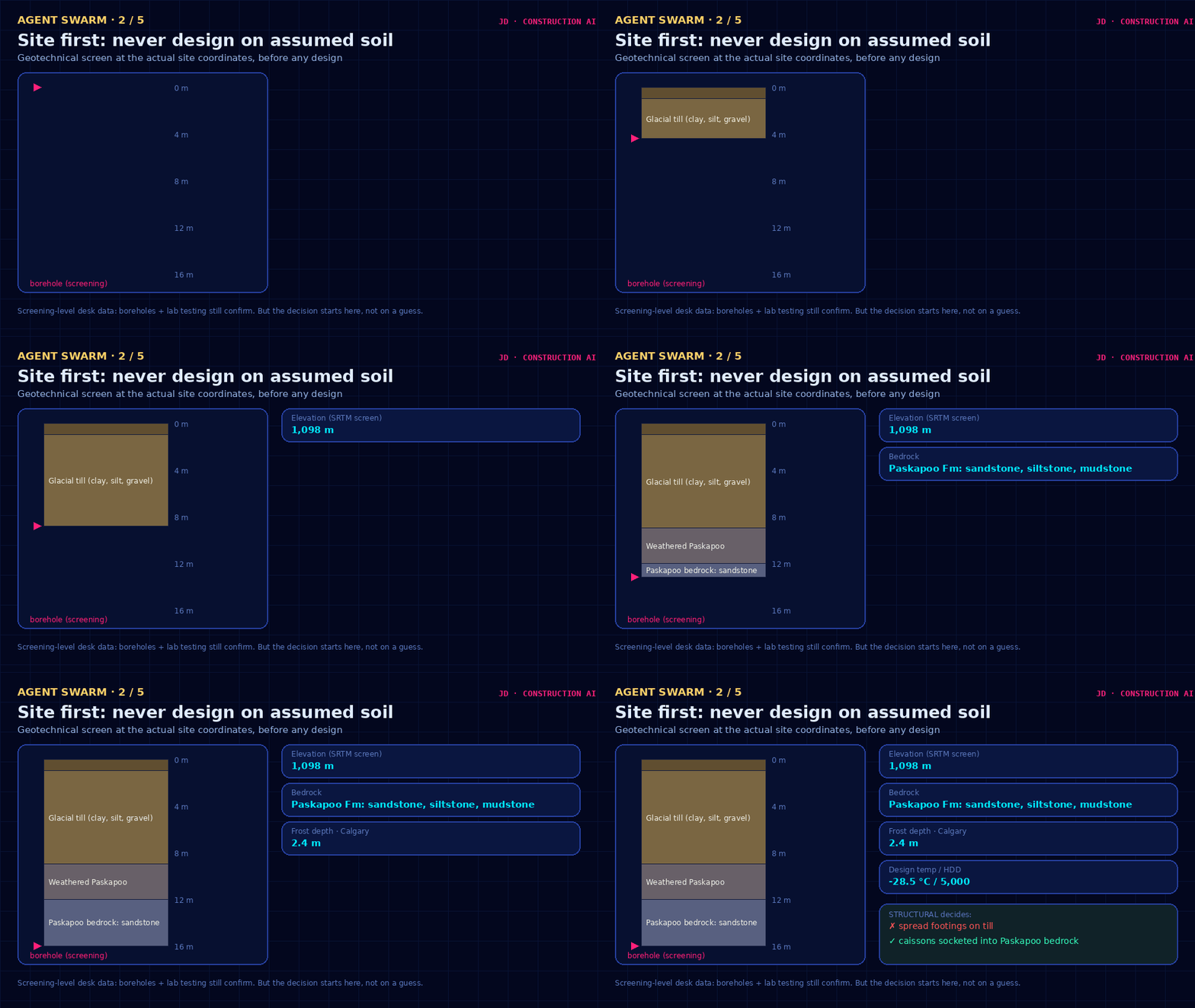
2 · Site first: geotech before design
A live geotechnical screening at the site's coordinates: 1,098 m elevation, Paskapoo Formation bedrock, 2.4 m frost penetration, −28.5 °C design temperature. Structural determinations are evidence-derived, never assumed.
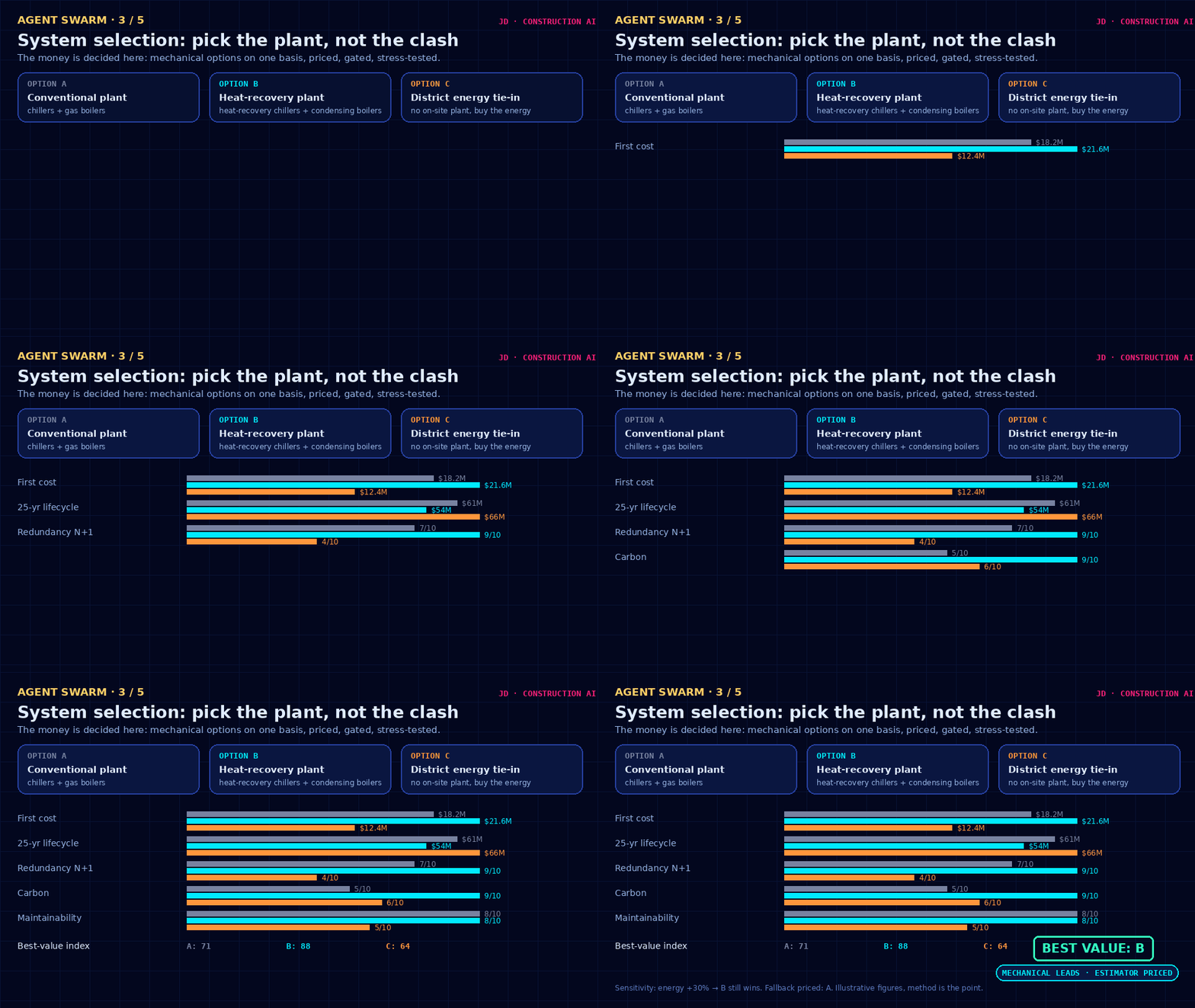
3 · System selection: pick the plant
The high-value determination is made early: which central plant serves 127,000 m² across a 25-year horizon. Mechanical leads a common-basis options evaluation (capital cost, lifecycle cost, redundancy, carbon intensity), the Estimator prices each alternative, and a sensitivity analysis stress-tests the verdict.
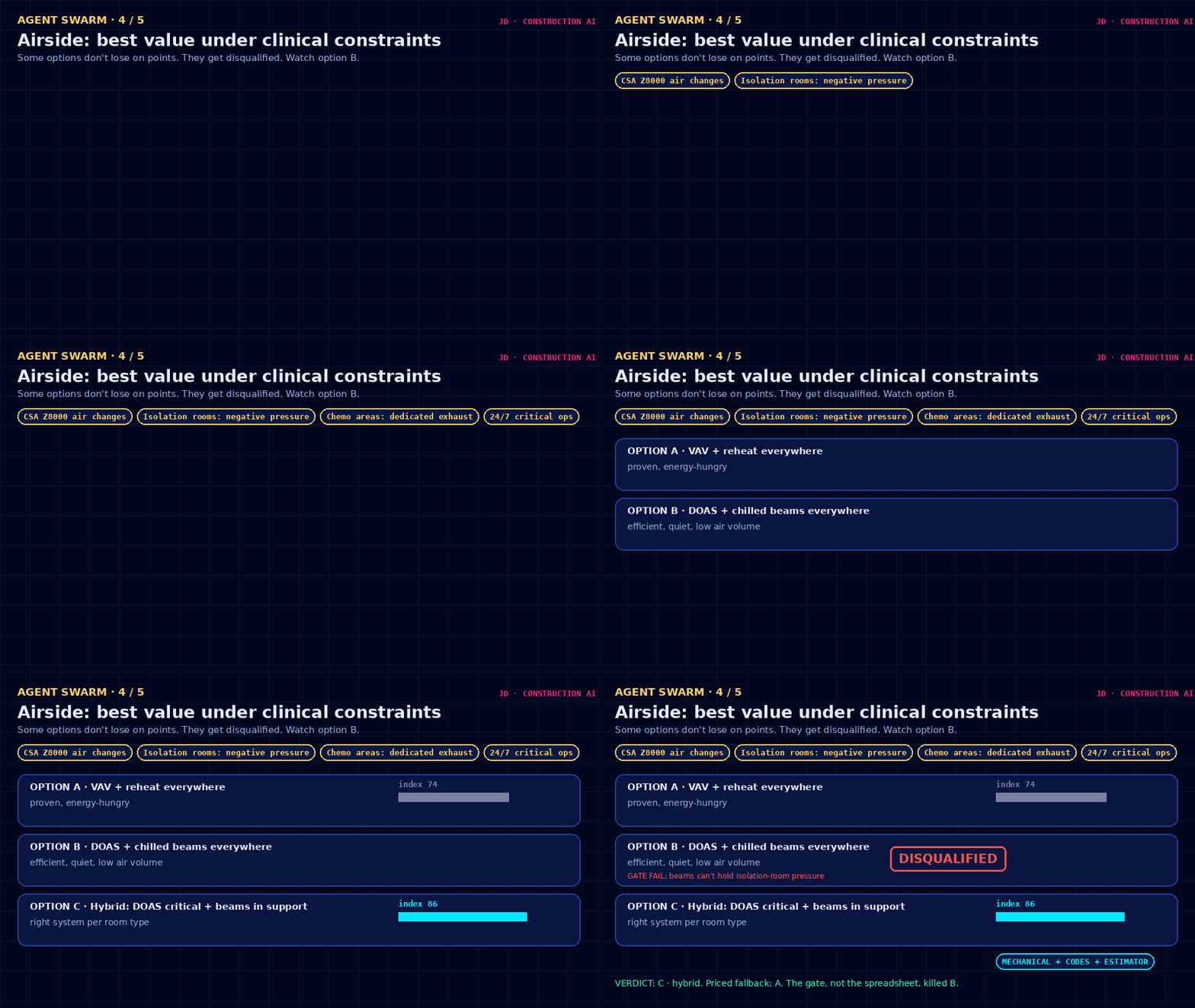
4 · Airside: best value under clinical constraints
Some alternatives are not outscored, they are disqualified: universal chilled beams fail the isolation-room pressurization gate. The hybrid prevails: dedicated outdoor air where clinical protocol mandates it, beams where it does not, with a priced contingency alternative.
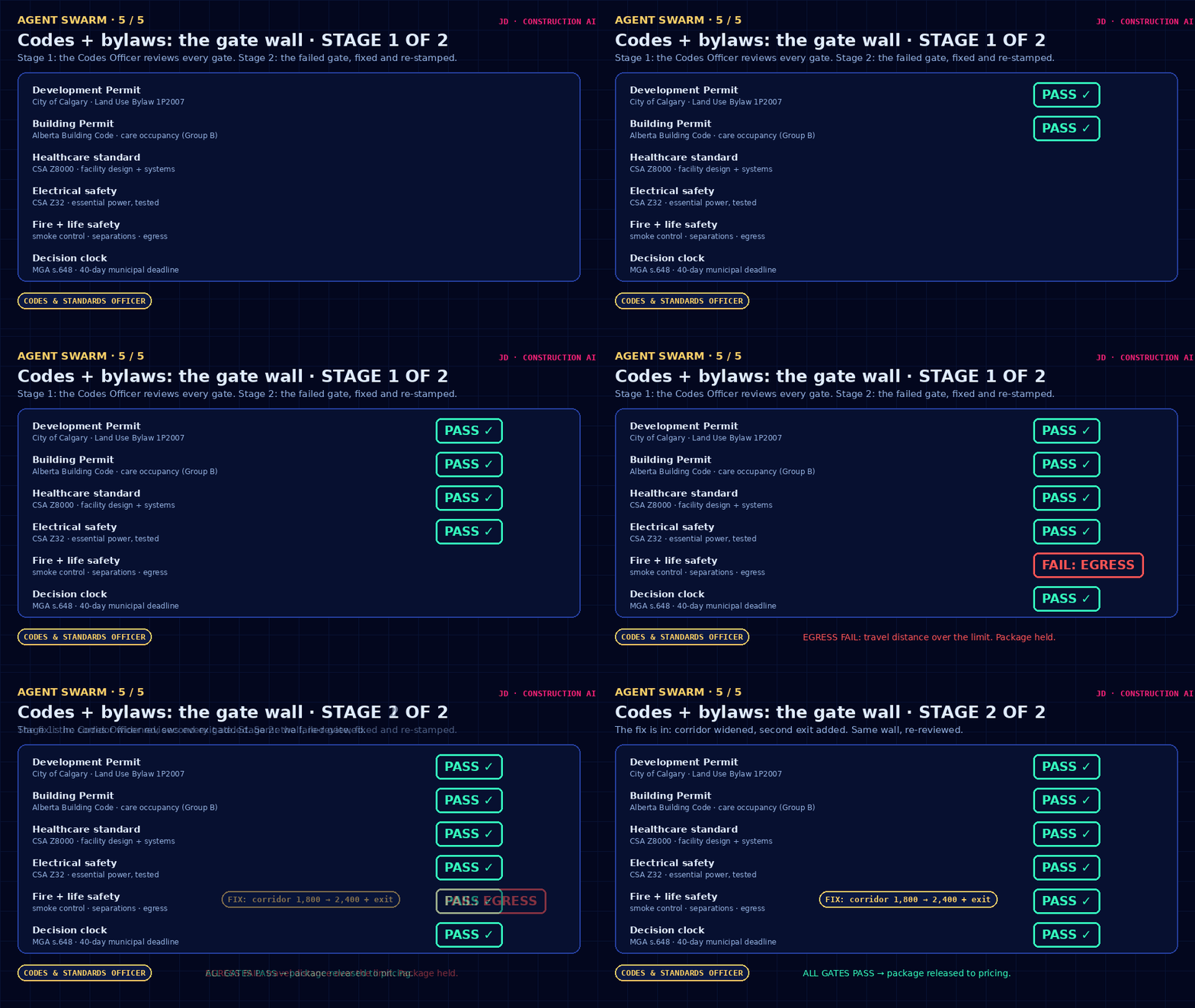
5 · Codes + bylaws: the gate wall
Two stages. Stage 1: the Codes Officer adjudicates every compliance gate, and egress fails. Stage 2: the remediation is incorporated and the wall re-adjudicates to all-pass before the package is released to pricing.
Legal + risk on the same case
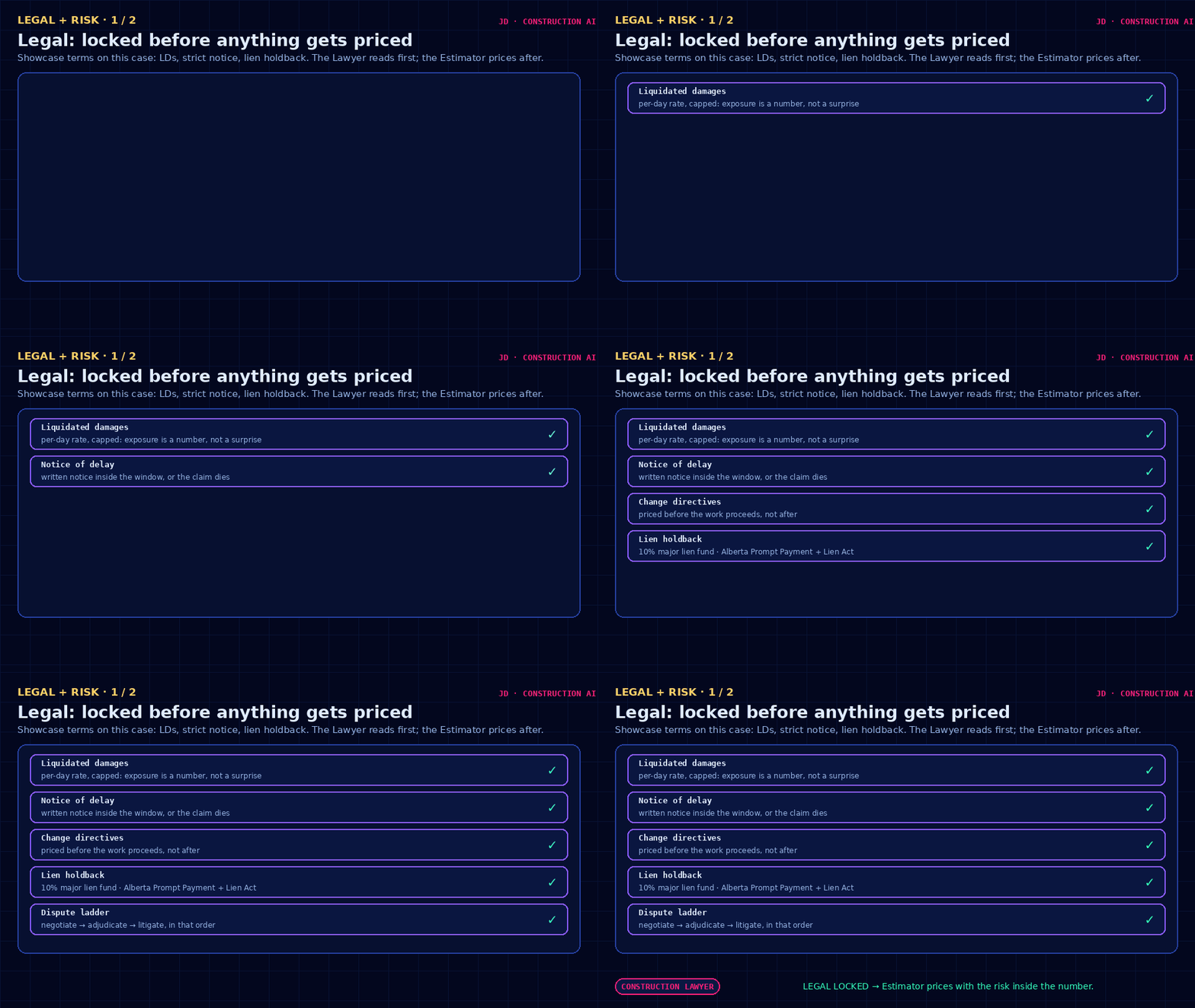
Contractual instruments modelled in full on this case: liquidated damages, strict notice regimes, statutory lien holdback, 50/50 surety bonding, builder's risk, wrap-up liability.
1 · Legal locked before pricing
The Lawyer resolves the clause stack first: liquidated-damages exposure quantified, notice windows, change-order pricing mechanics, the 10% Alberta lien holdback, the dispute-resolution ladder. Only then does the Estimator price.
2 · The risk stack
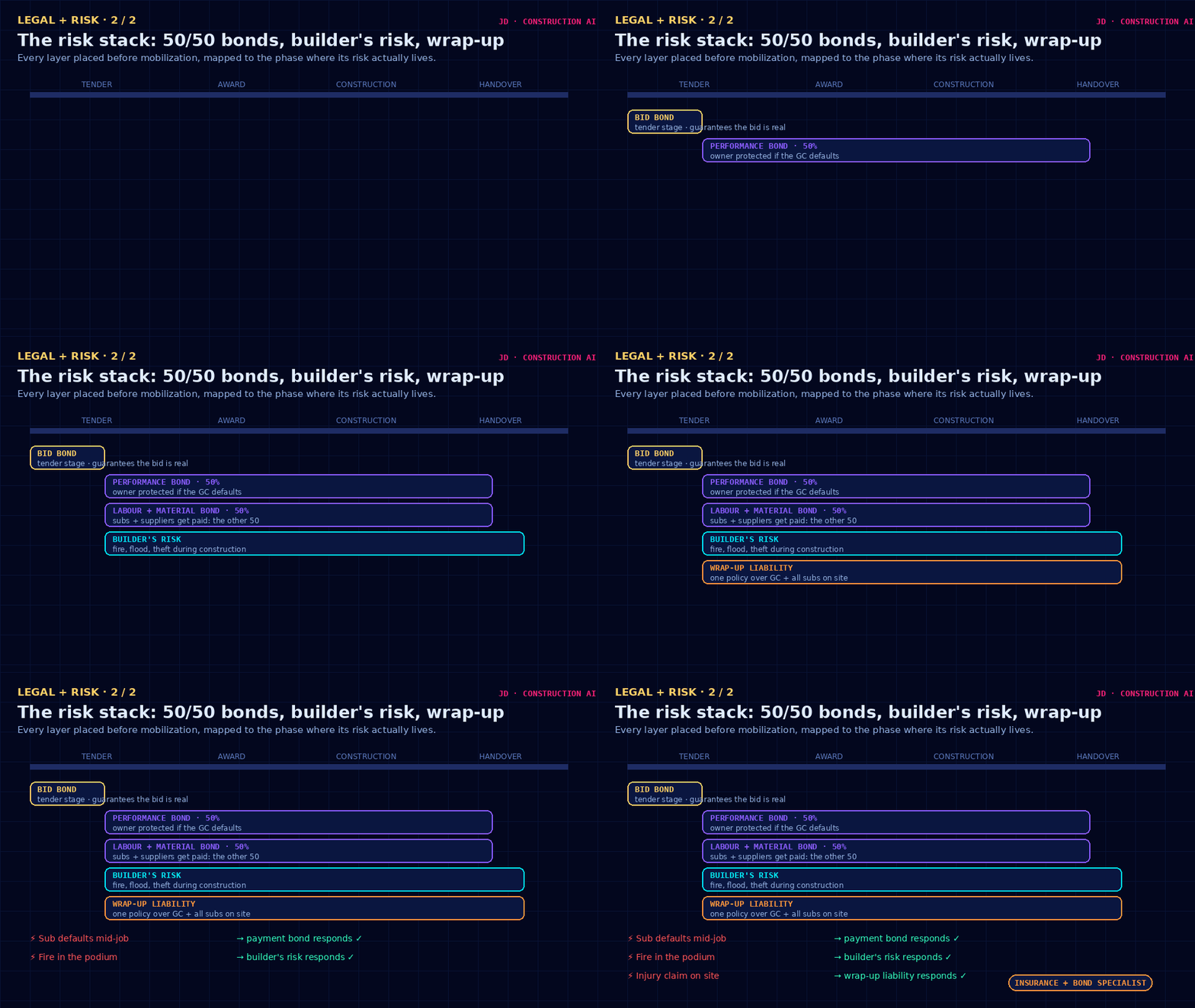
Bid bond at tender; 50% performance and 50% labour-and-material bonds at award; builder's risk and wrap-up liability through construction. Each instrument mapped to the risk stratum it occupies, and to the response mechanism when it triggers.
How a Level 4 schedule gets built
Five stages, project brief to deliverable, inside one pipeline. Steps 1–4 build an illustrative school (3-storey K-9, 8,200 m², Calgary). Step 5 freezes that network as ground truth and issues the Level 4 package.
Step 1 · Intake: brief in, evidence first
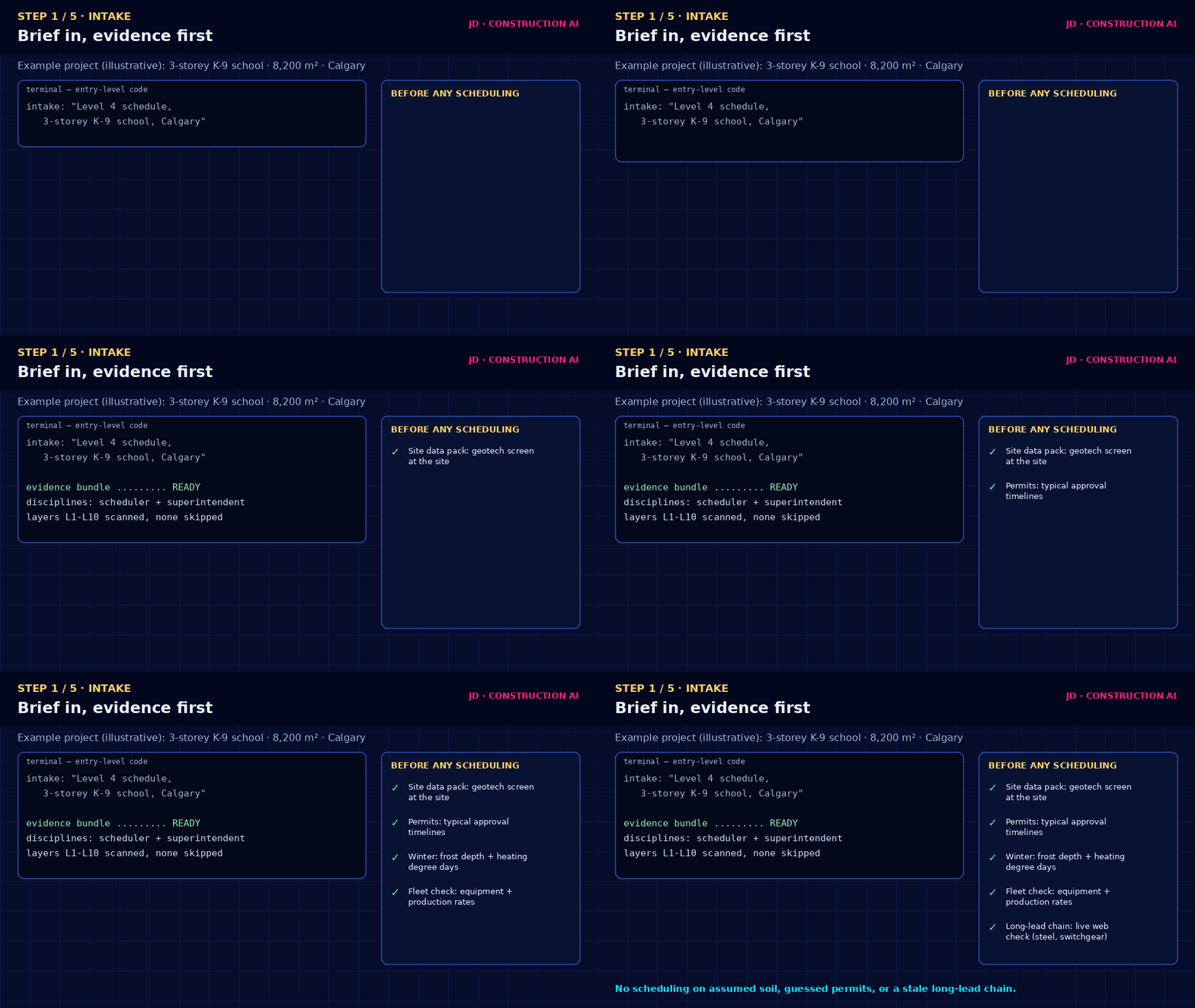
A decision model classifies the project brief first: schedule type, adjudicated behind a 0.90 confidence gate, the label selecting the execution playbook and the comparable-project set the network is synthesized from. Sub-gate, a deterministic router adjudicates and the divergence is flagged, never suppressed. The evidence pack then assembles: geotechnical screening, permit-duration distributions, winter-severity data, fleet capability, and a live verification of the governing long-lead procurement chain. No schedule is built on assumed soil.
Step 2 · Classify + skeleton
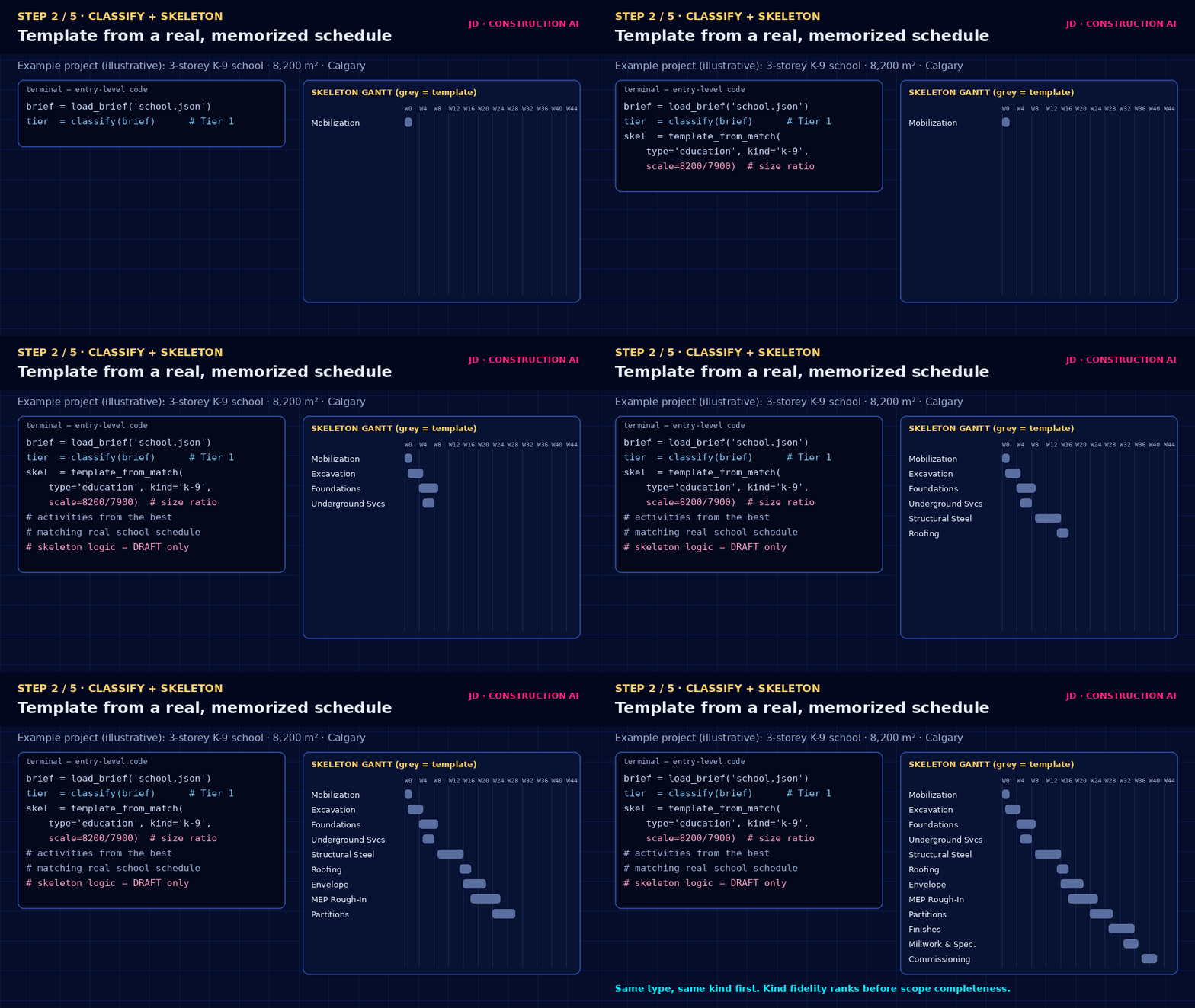
The brief is assigned a detail tier (a rich brief earns Tier 1, full parametric detail). A network skeleton is synthesized from the best-matching executed schedule of the same type and kind, scaled by size ratio. Its precedence logic is draft only: a template, not a determination.
Step 3 · Superintendent: scope + quantity durations
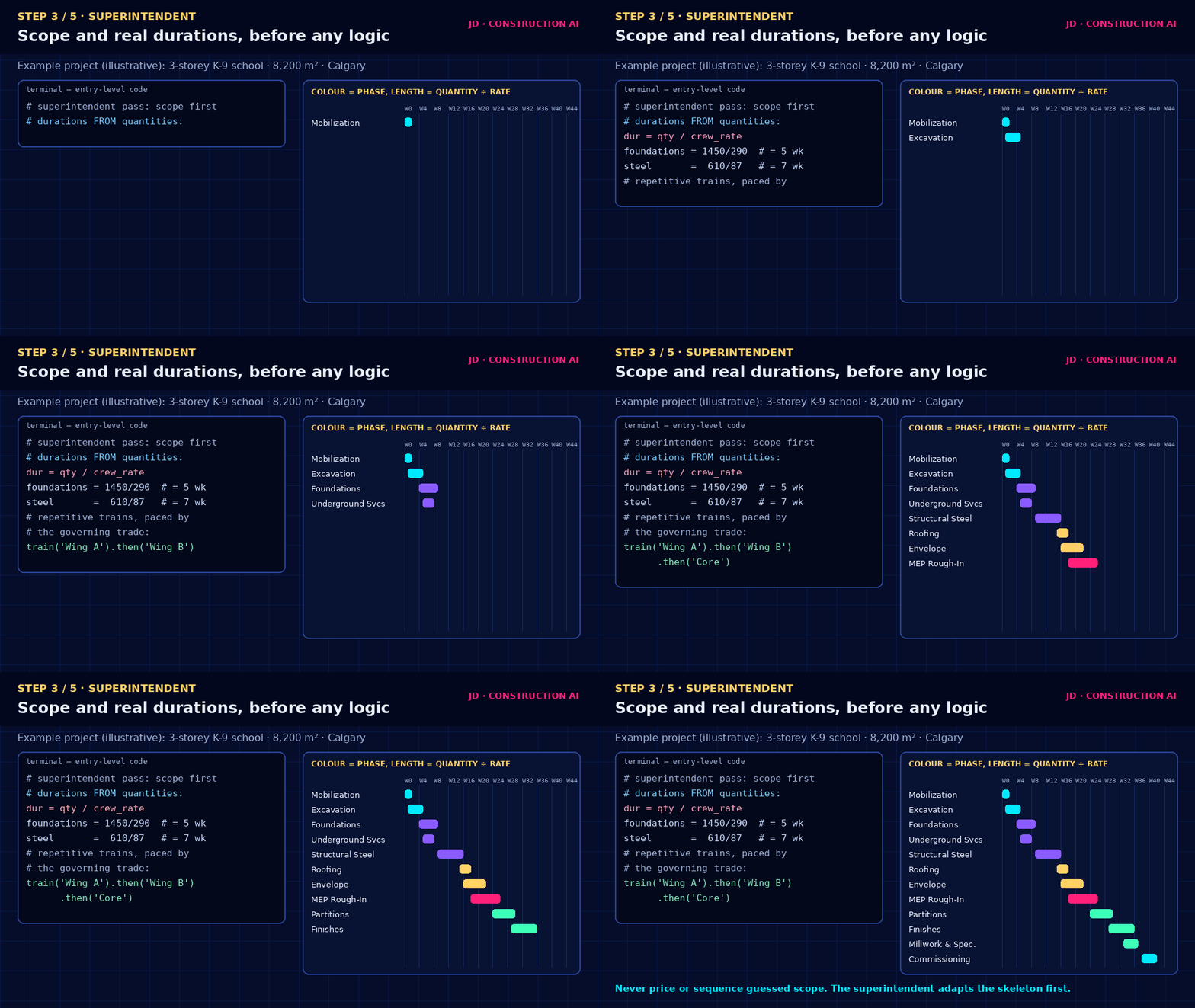
The superintendent adapts the skeleton to the project's actual construction methodology. Durations are pure arithmetic: quantity divided by crew production rate (1,450 m³ of foundations at 290 m³/week = 5 weeks). Repetitive work is sequenced as production trains paced by the governing trade.
Step 4 · Scheduler: logic + CPM in code
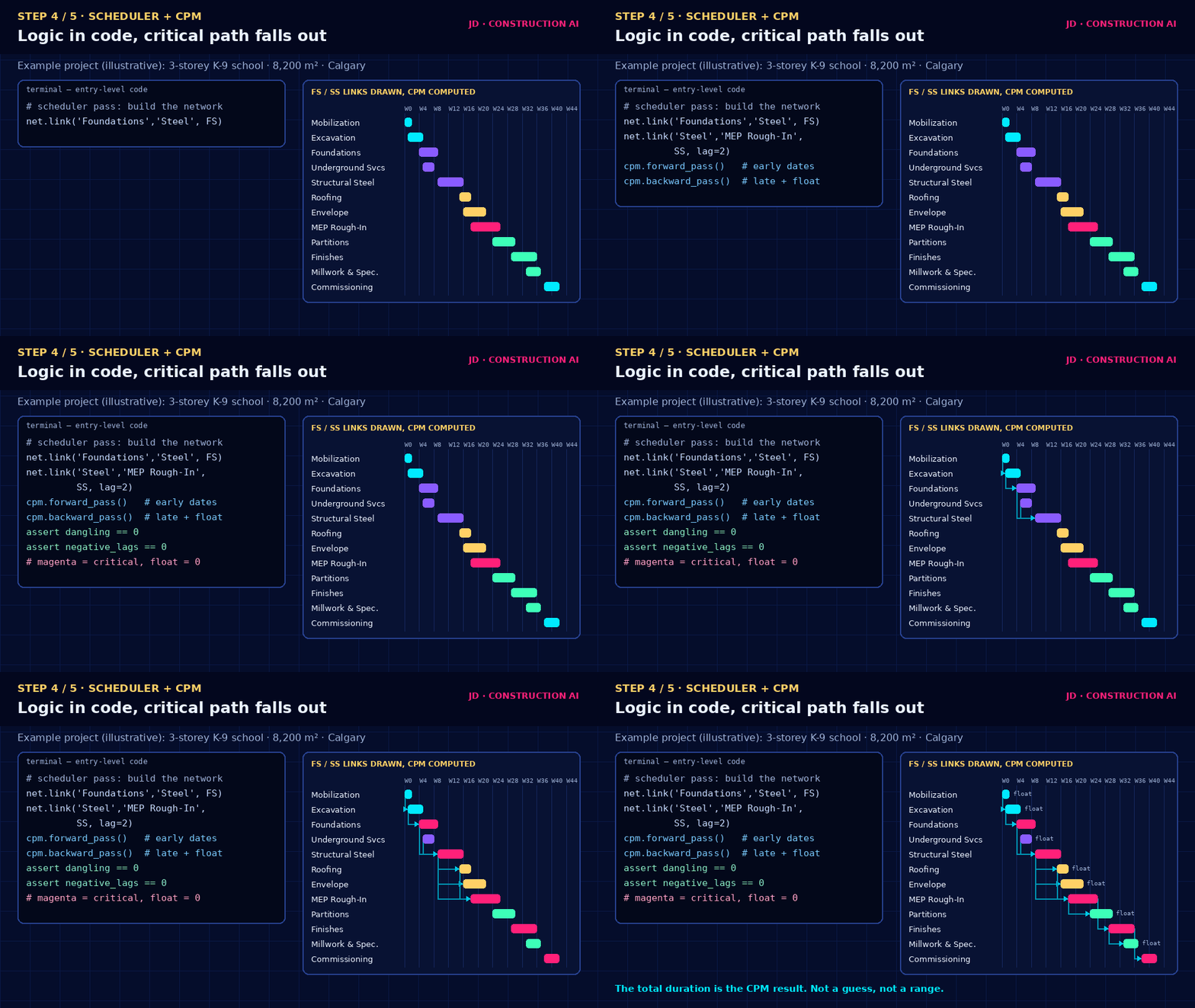
The scheduler constructs the network deterministically: FS, SS and FF precedence relationships between activities, a forward pass computing early dates and a backward pass computing total float, all evaluated in code. Release assertions: zero dangling logic, no negative lags. Magenta denotes the critical path: float zero.
Step 5 · Freeze + deliver: the Level 4 breakout
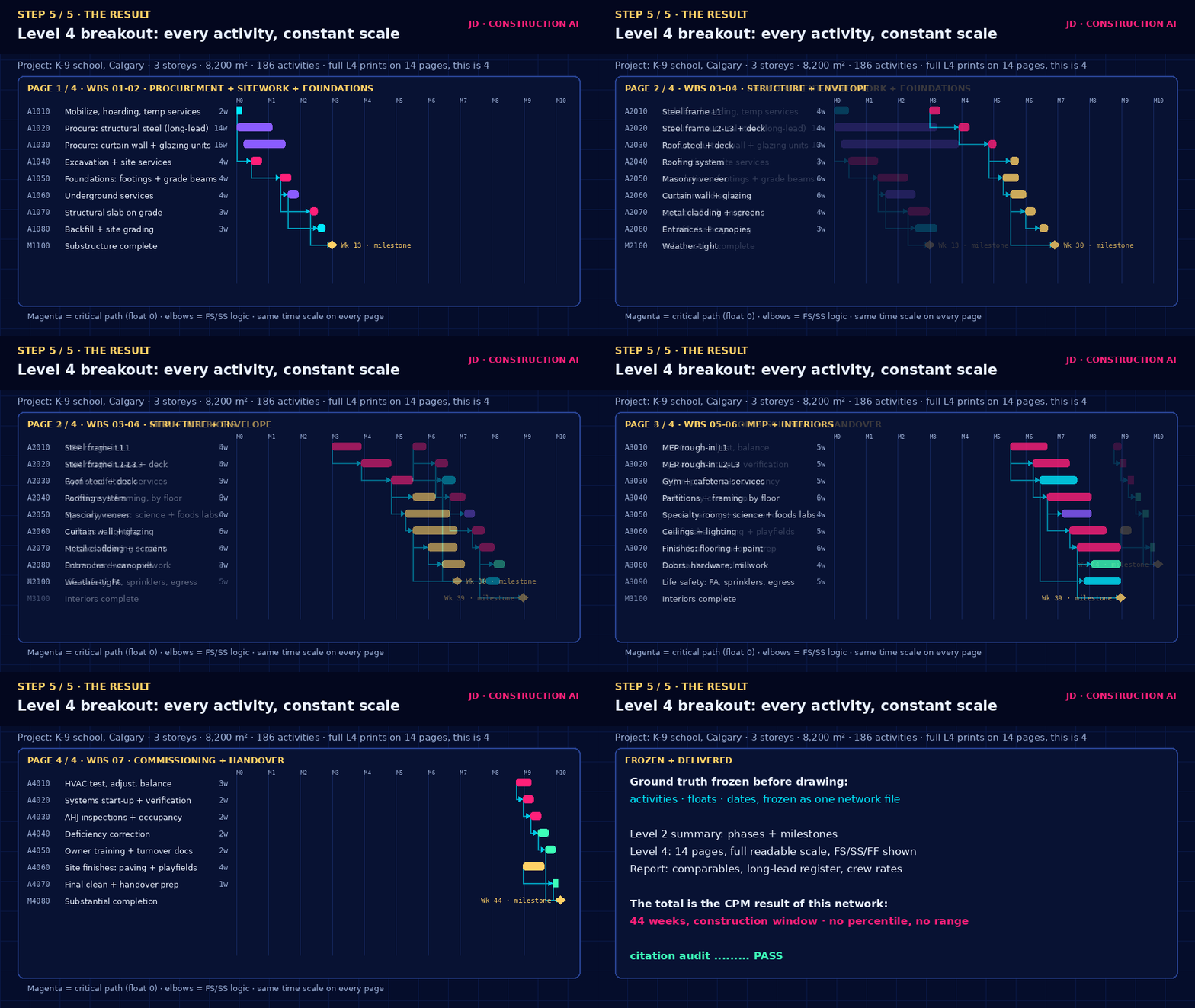
The network is frozen as ground truth before anything is rendered. The deliverable is the same school the first four stages constructed: 186 activities at a constant time scale, paginated as the Level 4 prints (FS/SS precedence arrows throughout, critical path in magenta, contract milestones as diamonds). The total is the CPM determination of the network itself: 44 weeks, construction window. No percentile, no range: computed, not benchmarked.
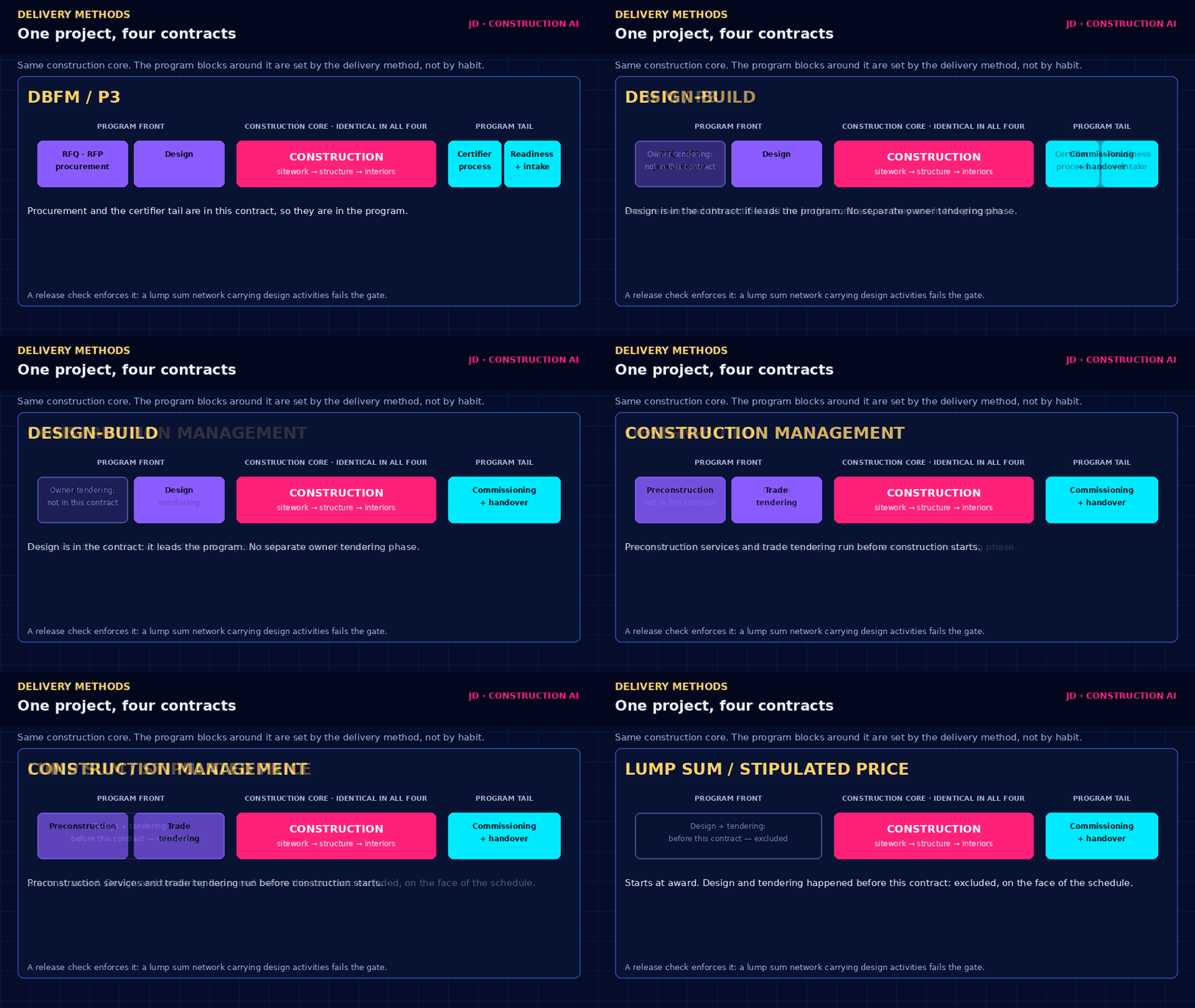
One project, four contracts
Program architecture is derived from the delivery method, never from habit. DBFM carries a procurement front-end and an Independent Certifier tail. Design-build carries the design front-end. CM carries preconstruction and trade tendering. Lump sum commences at award: construction only, the boundary declared on the face of the schedule. A release assertion enforces the correspondence before anything ships.
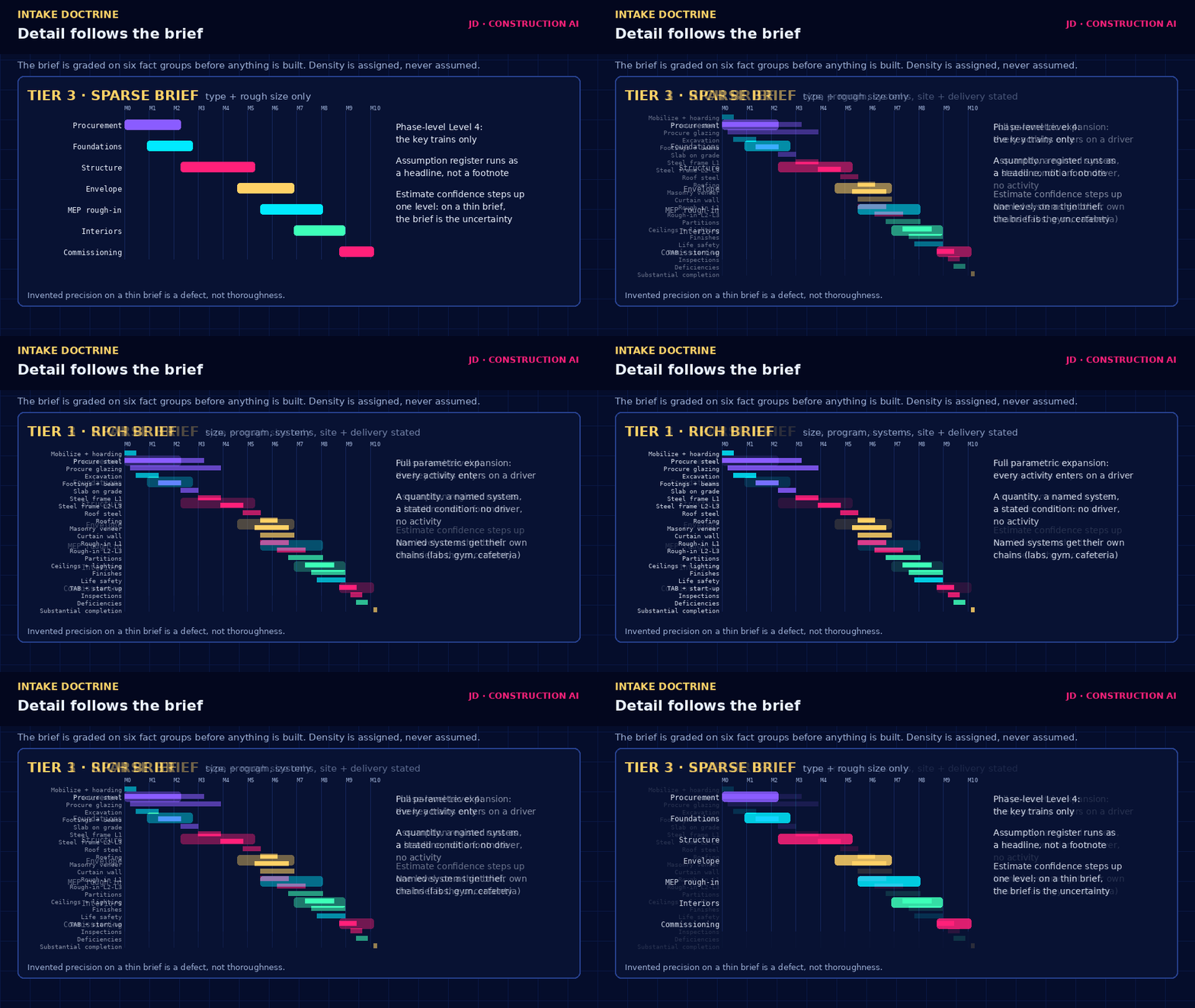
Detail follows the brief
Intake stratifies the brief across six fact groups: identity, magnitude, program, systems, site and delivery, time. A rich brief earns full parametric detail, every activity admitted on a governing driver. A sparse brief earns an honest phase-level schedule, its assumption register carried as a headline, and the estimate ascends a confidence level to price the uncertainty the brief itself introduces.
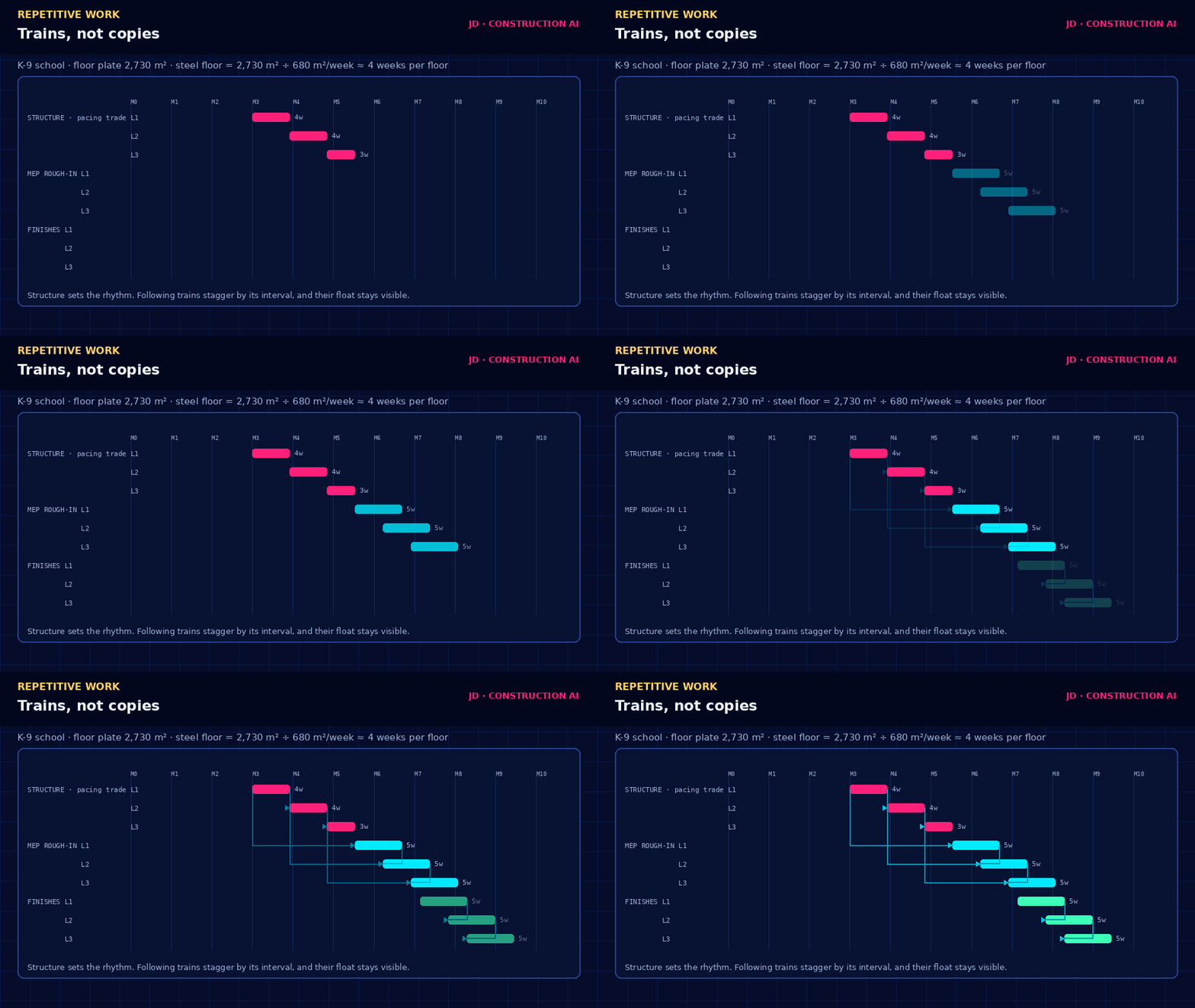
Trains, not copies
Repetitive work is never scheduled as parallel duplicates. Each unit's duration is its quantity divided by a crew production rate, and the units run as trains staggered by the pacing trade. The same rule constructed the school's floors in Step 5: structure paces, rough-in and finishes follow, their float exposed, never buried.
📦 Project Brief: Pleasant Hill Library, California
Project brief: a new public library. Program: a 650-activity Level 4 CPM network across 70 work sections, 9 contract milestones, 623 FS/SS precedence relationships, and a 140-activity driving path. Procurement and risk are controlled inside the network topology, never appended after it.
The package: basis of schedule and assumption register, Level 2 summary, the full Level 4 Gantt, long-lead procurement register, and risk controls.
Schedule QC: hand it an existing schedule
The pipeline re-derives the network from the brief and the quantities, then reconciles it against every prior build of the same project. Totals and dated events are compared line by line, and every material divergence is attributed to a named cause. What survives is a verdict with reasons, not a cosmetic pass.
| Build | Total | Structure top-out | Weathertight | Systems live |
|---|---|---|---|---|
| Prior build 1 | 47 wk | wk 26 | wk 33 | wk 38 |
| Prior build 2 | 45 wk | wk 25 | wk 31 | wk 37 |
| This rebuild | 44 wk | wk 24 | wk 30 | wk 36 |
Attributed causes for the 3-week variance to Prior build 1: procurement chain re-derived from quantities, −1 wk. Permit bifurcation releases excavation antecedent to placements, −1 wk. Logic reconstructed with zero dangling relationships, −1 wk. Illustrative comparison on the school example.
How an estimate gets built
The cost discipline of the same pipeline, executed on the same illustrative school (3-storey K-9, 8,200 m², Calgary, 2026 CAD).
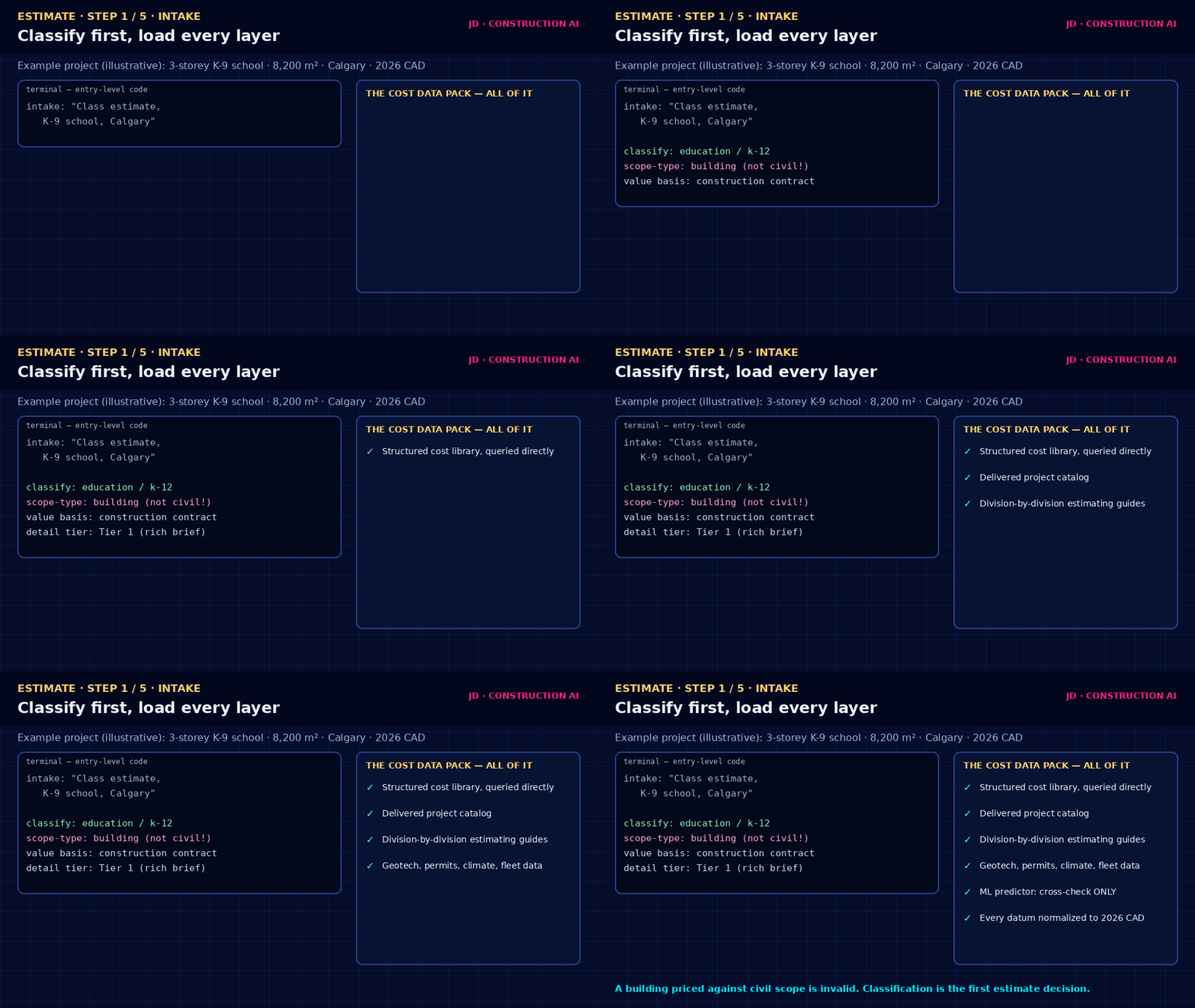
Step 1 · Intake + classify
A decision model classifies the project brief first: cost class, adjudicated behind a 0.90 confidence gate, the label selecting the estimating template and the comparable set. Kind, scope-type, and value basis are fixed by deterministic rule before any quantity exists: a building priced against civil scope is invalid. The full cost data pack then loads: a structured unit-rate repository, the delivered-project catalog, benchmark bands, division-by-division guides, geotechnical, permit, climate and fleet data, and a predictive model admitted only as a cross-check. Every figure is normalized to 2026 CAD.
Step 2 · Skeleton from a delivered comparable
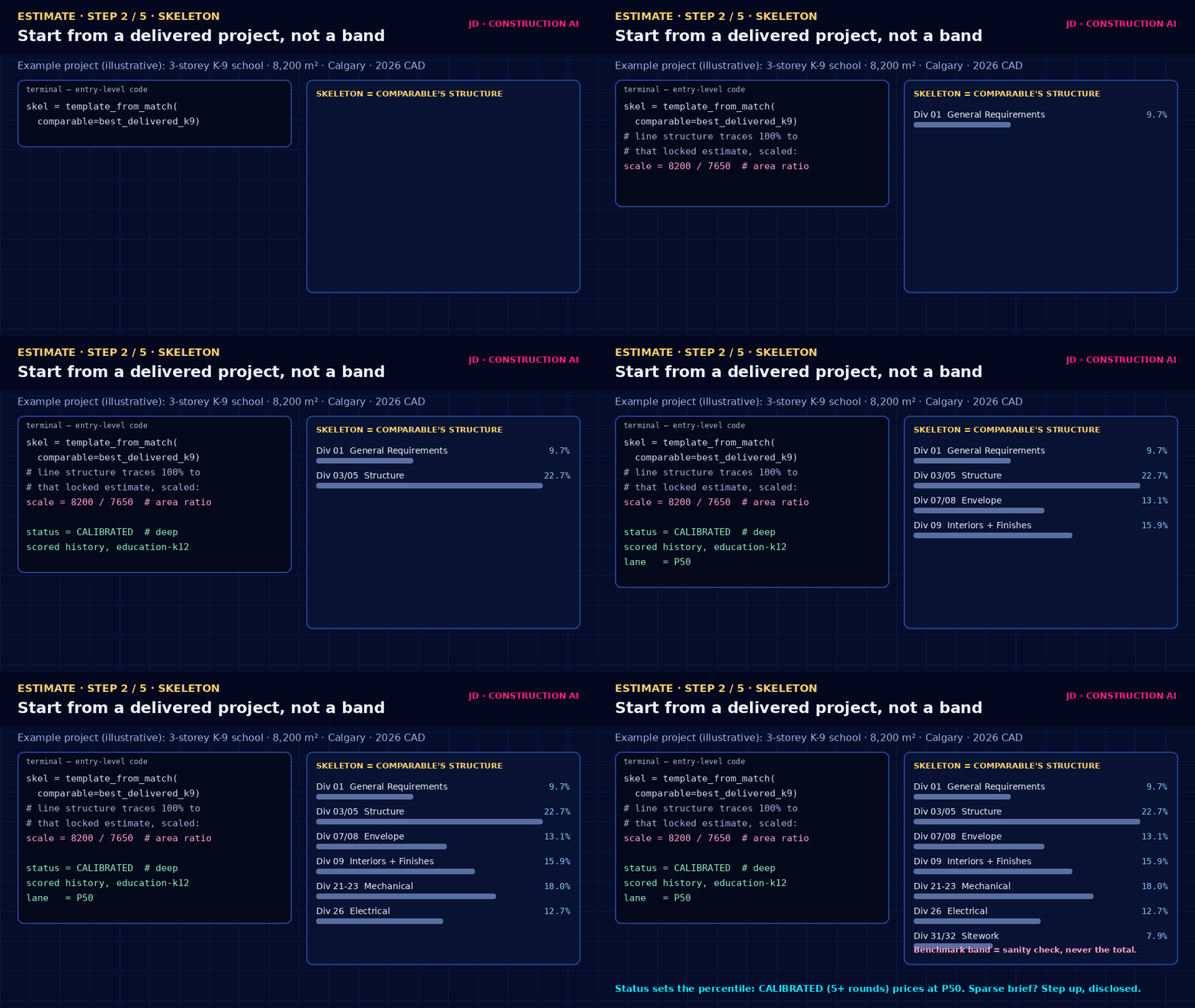
The estimate originates from the best delivered comparable's locked estimate: its line structure traces completely into the skeleton, scaled by area ratio. The class carries CALIBRATED status from a deep bench of scored rounds, so this prices at P50. Benchmark bands are a corroborating check, never the total.
Step 3 · Scope + duration first
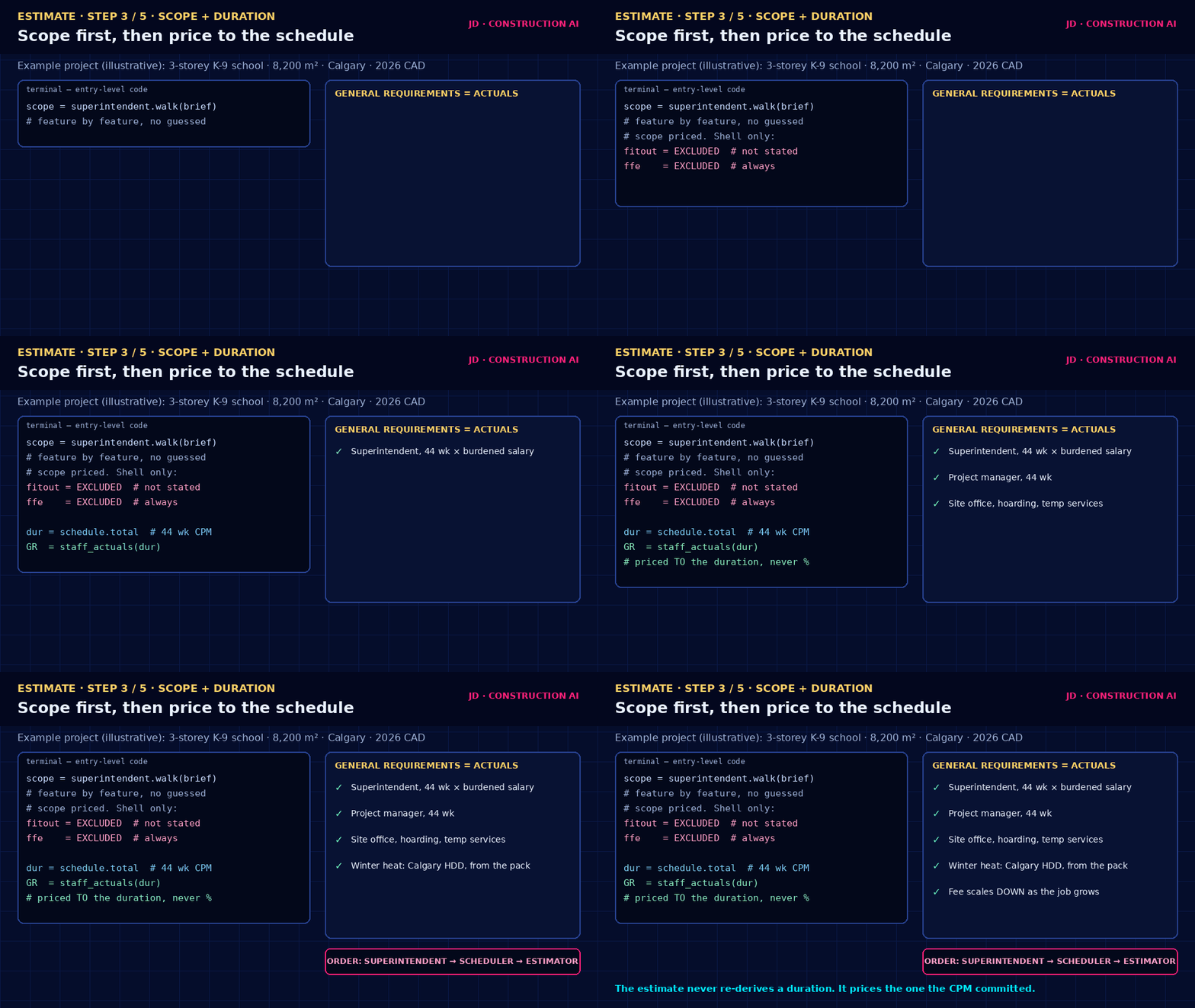
The superintendent interrogates the brief feature by feature. Shell-only where fit-out is not stated; FF&E excluded categorically. The scheduler's committed duration (44 weeks, from the CPM) then prices General Requirements as staff actuals, never as a percentage. The estimator never re-derives a duration.
Step 4 · Build-up + rate verification
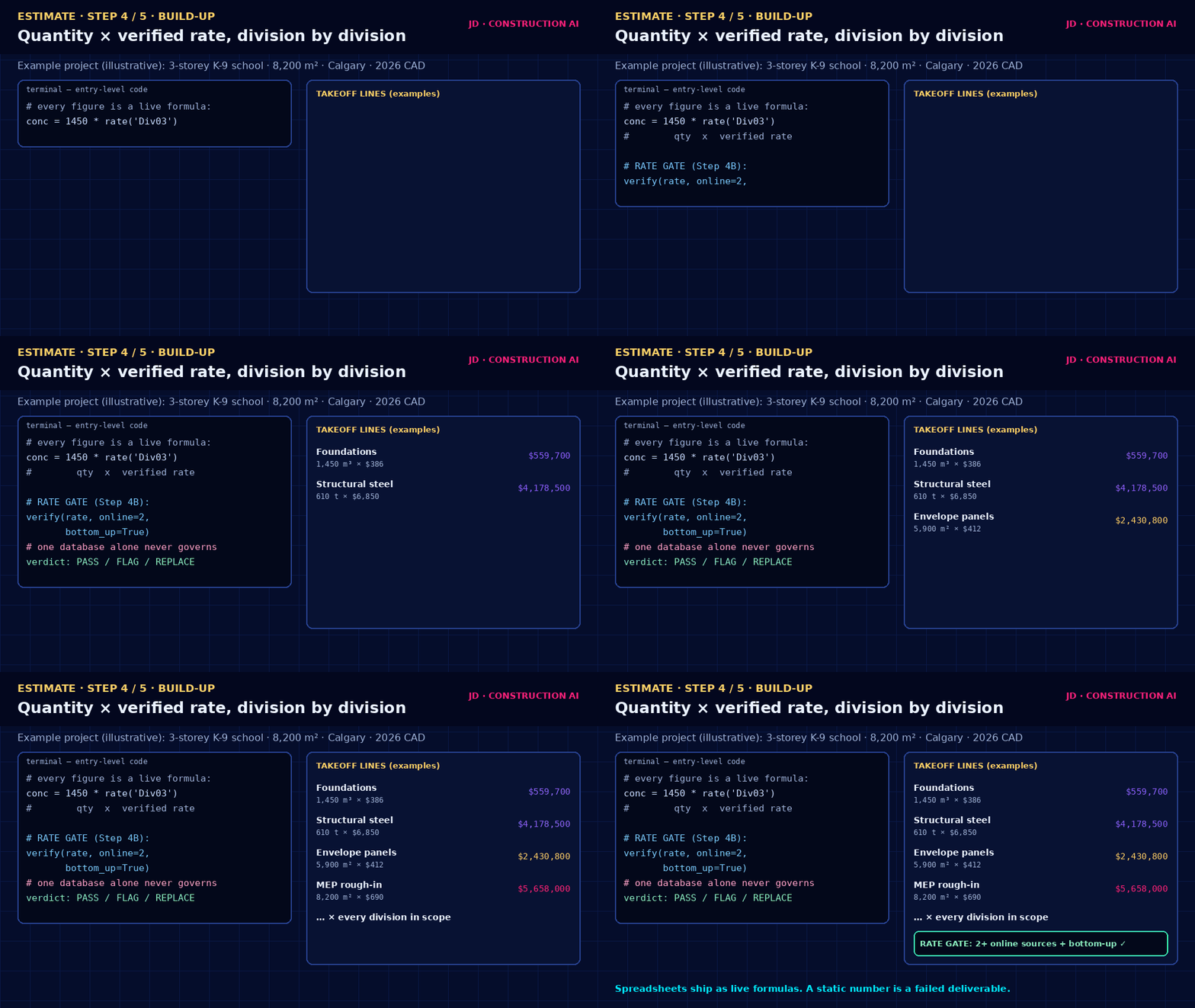
Division by division, quantity multiplied by rate, every figure a live formula. Any governing rate first passes the verification gate: triangulation across two or more independent market sources plus a bottom-up reconstruction, with a verdict per rate. A single database is a point of departure, never proof.
Step 5 · Level pass + release
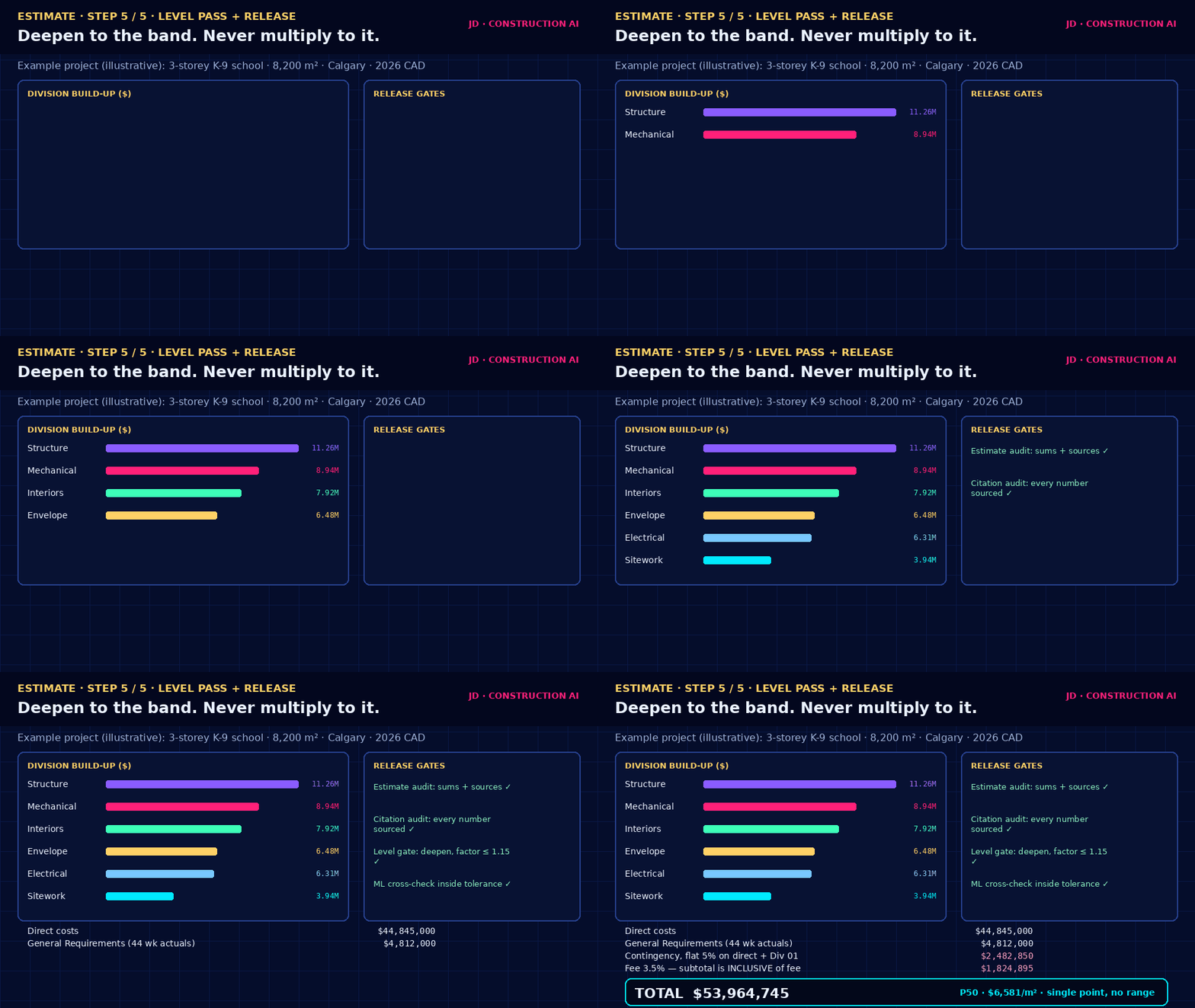
The level pass is arithmetic: deepen the takeoff to the band, never multiply to it (a factor over 1.15 declares the takeoff under-built). Then the release gates: the estimate audit, the citation audit, and the predictive cross-check. Contingency is a flat 5% on direct costs plus Division 01, fee applied above it, and the headline subtotal is inclusive of fee. One number: $53,964,745 at P50, $6,581/m². Single point, no range.
Experience
Intermediate Estimator — Ledcor, Calgary (May 2023 — Present)
Estimates across all scopes and disciplines, under every delivery method: Lump Sum, CM @ Risk, DBFM. Preconstruction support and value engineering, structural concrete quantification from 3D models, and advanced data analytics: automation, Bluebeam/Excel, and cost, schedule, and risk prediction.
Project Coordinator — Ledcor (Sep 2022 — May 2023)
Coordinating four LEED Silver warehouse and industrial condominium projects aggregating $100M.
Builder — Construction AI program
Designed and built the pipeline above: discipline profiles, stratified evidence retrieval, sealed blind calibration rounds that quantify its accuracy without flattery, and the schedule and cost generation workflows.
Selected projects: estimating
Named projects below aggregate $3.1B across estimating and coordination. Inclusive of NDA engagements, the portfolio runs to $5B in project value.
Selected projects: coordination (2022–23)
Credentials + toolkit
McGill University — MMA
Master of Management in Analytics, in progress. Decision analytics, mathematical optimization, machine learning.
SAIT — BSc Construction Project Management
Graduated 2025. Estimating, scheduling, and project delivery derived from first principles.
Get in touch
CURRENT POSITION
Intermediate Estimator @ Ledcor · McGill MMA in progress
| Base | Calgary, Alberta |
| Language | English and Vietnamese |
| dhuy715444@gmail.com |